
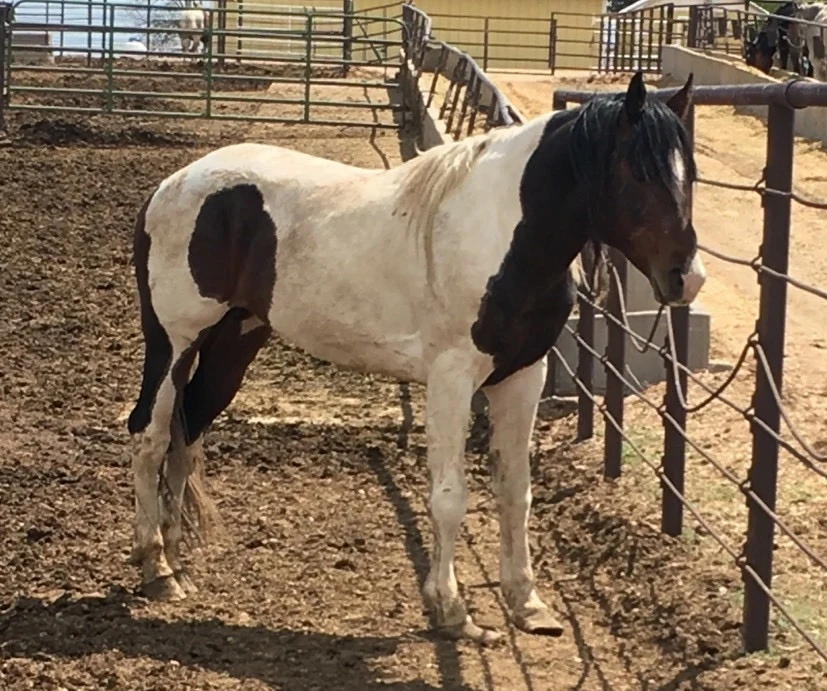
This conversation has made its way around the horse world again, and now onto the Badly Behaving Bettys page, so I decided it was time to put my thoughts in one place. I am sure some people will assume my response is about the comment that someone has eaten horse meat. It isn’t.
This is also not about attacking the trainer whose comments started the discussion. I don’t know her personally, and I have actually seen her raise other issues within the horse industry that I agree with or think are worth talking about. We can disagree strongly on one issue and still have common ground on others. I am actually glad she posted this because it gave us a forum to talk about the bigger question: if horses are going to slaughter anyway, wouldn’t bringing regulated horse slaughter back to the United States be more humane because they would not have to travel as far?
These are the posts that brought the argument back into the conversation. They are included for context. This article challenges the idea — not the individual behind it.
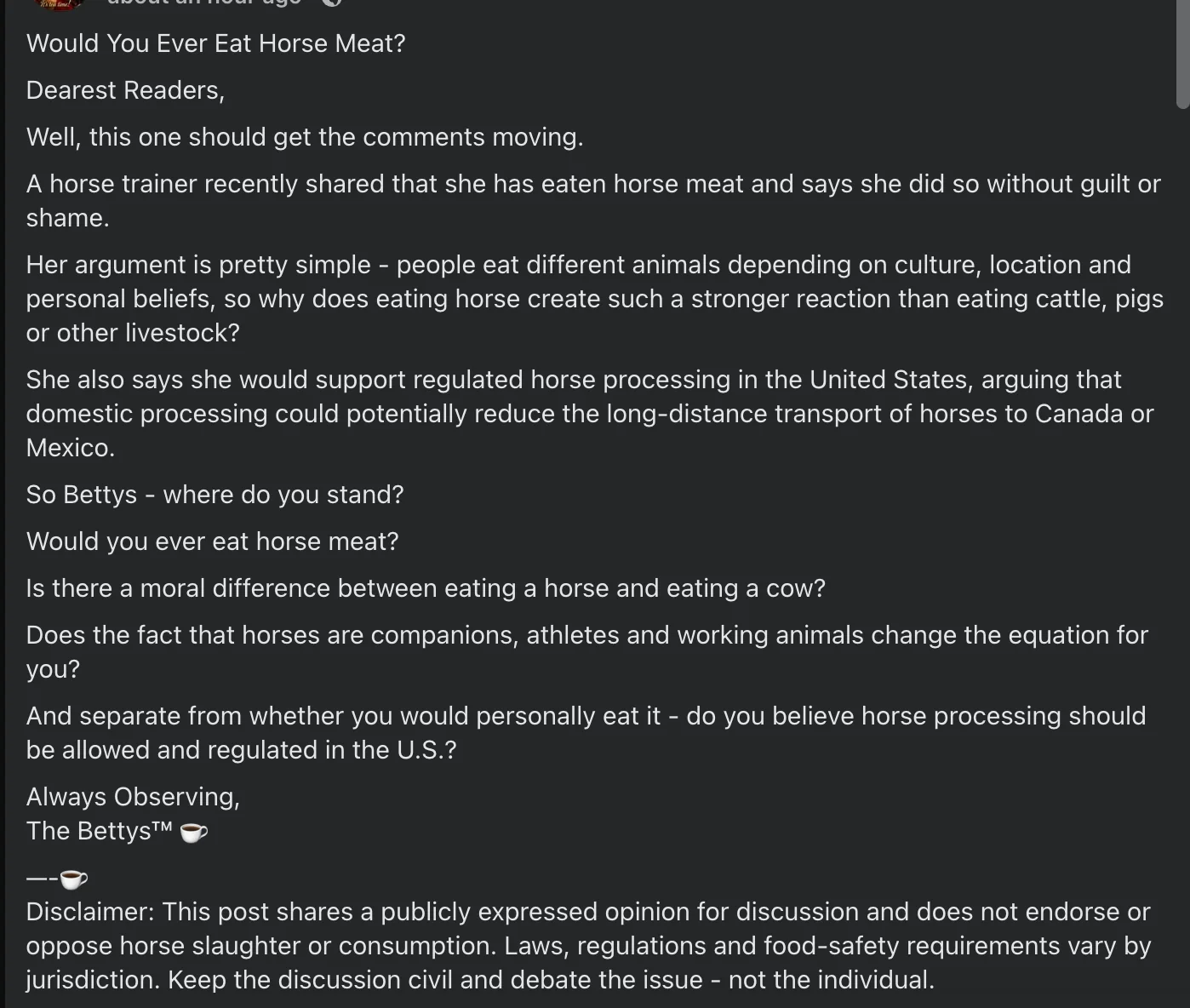
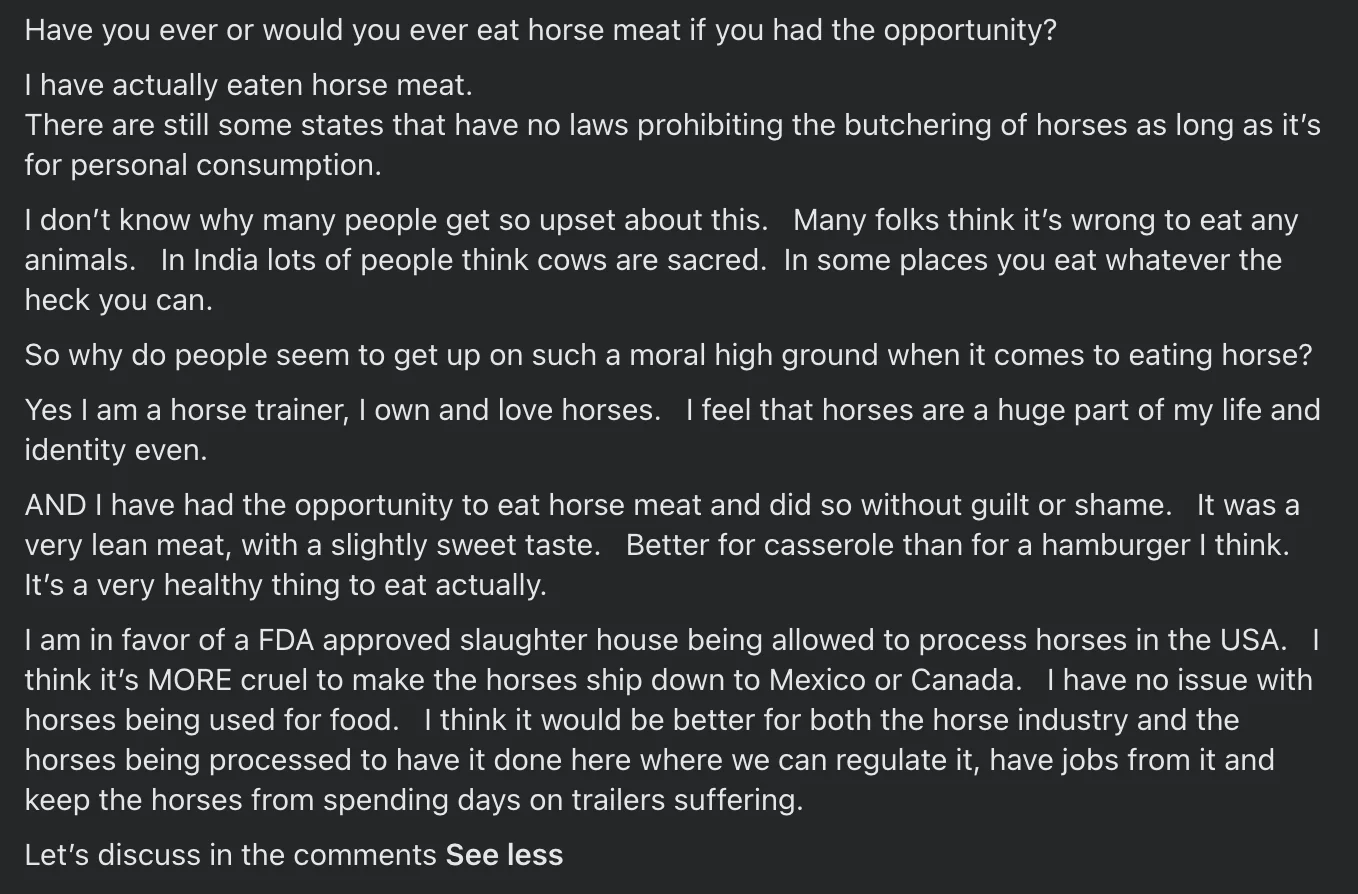
No. I don’t believe it would. And I think that argument begins the conversation way too late.
Whether I would personally eat horse meat is not the question I want to spend this article debating. The question that matters to me is why the horse is standing in the slaughter pipeline in the first place.
The suffering does not begin when a horse is crammed onto an overcrowded slaughter-bound truck headed for Canada or Mexico. By that point, many of these horses have already spent days, weeks or longer moving through a system that was never designed with their welfare as the priority. It can begin in the first auction pen, then another sale, then a trader, another holding pen, another buyer and eventually a kill pen. Horses are mixed with unfamiliar animals, hauled repeatedly, exposed to disease, stressed, injured, dehydrated and sometimes dealing with respiratory illness or colic. Horses who were already compromised can deteriorate quickly. Some never even make it to that final slaughter-bound truck.
Moving the slaughterhouse closer does not eliminate any of that. It does not eliminate the low-end auction, the traders, the repeated hauling, the holding pens or the horses changing hands over and over with little continuity of care. It simply changes where the horse ultimately dies. That is not the same thing as solving a welfare problem.
USDA-based annual data compiled by the Animal Welfare Institute show that 25,128 American horses were exported for slaughter in 2025 — 21,430 to Mexico and 3,698 to Canada. Twenty-five thousand one hundred twenty-eight horses. And those are the ones reflected in the available slaughter-export numbers. Anyone who has ever tried to follow a horse through low-end auctions, private sales, traders and repeated ownership changes knows how quickly the trail can become difficult or impossible to follow. That is not a reason to throw our hands up and say we can never track them. It is exactly why we need a better system. Source: Animal Welfare Institute, citing USDA data
People are already willing to put horses into this pipeline knowing the final destination may be Canada or Mexico and knowing the haul is long. So I do not believe making disposal closer, easier and more convenient is somehow going to inspire more responsible horse ownership.
I worry it does exactly the opposite.
If there is always an easy outlet for the horse who didn’t win, didn’t breed the foal somebody wanted, didn’t become that one-in-a-million prospect, got hurt, got old, became expensive or simply became inconvenient, where is the pressure to change what happens upstream? I am not saying every breeder, trainer or owner operates this way. Of course they don’t. There are incredible people in this industry who follow their horses, take them back, spend the money and genuinely care where they are years later. But good people existing inside a system does not mean the system has enough safeguards.
Would bringing slaughter back actually eliminate the middleman?
After I wrote this, one of my dearest friends raised an argument I had not really stopped to examine from that angle: what if we reopened USDA-regulated horse processing in the United States and at the same time prohibited horses from being transported to Canada or Mexico for slaughter? Wouldn’t that put the kill buyers out of business and save thousands of horses from the pipeline?
I love a good healthy debate, especially with someone I love and respect, so I went digging. The historical data made me even more concerned about bringing domestic slaughter back.
The first number that stopped me was more than 110.
The U.S. Government Accountability Office reviewed USDA documentation and found that more than 110 commercial slaughter-horse shippers were operating in 2005–2006, the two years before domestic slaughter ceased in 2007. By 2008–2009, after the U.S. plants had closed, fewer than 50 commercial shippers were operating. Source: U.S. Government Accountability Office
I want to use the GAO’s language precisely: it calls them commercial shippers, not “kill buyers.” But the economic function is the part we need to pay attention to. A slaughter plant needs a steady supply of horses. Somebody still has to acquire them, assemble loads and deliver them.
The GAO also reported that people in the horse industry and state veterinarians generally attributed the drop in commercial shippers to the closing of horse auctions, a smaller market and lower profit margins caused by the added cost of transporting slaughter-bound horses to Canada and Mexico. In other words, when slaughter became less accessible and less profitable, the commercial network supplying it shrank. Source: U.S. Government Accountability Office
That does not prove a future domestic market would look exactly like the old one. It does challenge the assumption that bringing slaughter back would automatically make the middleman disappear.
I also went looking for the legal mechanism that would make that happen. Under current federal rules, an individual or business that commercially transports more than 20 equines per year to slaughter facilities is defined as an owner/shipper. The rules require USDA backtags, owner/shipper certificates and transport records for slaughter-bound horses, including horses being moved to facilities outside the United States. Source: 9 CFR § 88.1 Source: 9 CFR § 88.4
USDA’s Packers and Stockyards program separately defines and regulates livestock dealers who buy and sell livestock, requiring registration and bonding. Source: USDA Agricultural Marketing Service
What I could not find in those existing rules was anything saying that simply moving the slaughter plant onto American soil would, by itself, prevent a dealer or commercial shipper from buying horses, reselling horses or looking for the best margin before those horses reached the plant. New legislation could certainly create additional restrictions. But that would be a different proposal from simply reopening U.S. slaughter plants.
Maybe the name changes. Maybe the route changes. Maybe the paperwork changes. The profit motive does not.
If there is money to be made finding unwanted horses, buying them cheaply, assembling loads, reselling some when there is a better margin and supplying the rest to a slaughter market, somebody will find a way to build a business around that opportunity. The fair question is not whether today’s kill-pen model would look exactly the same. It probably would not. The fair question is what specific law or market mechanism would prevent people making money in the middle from simply adapting to a domestic slaughter market.
Then I looked at the number of horses themselves. The U.S. Government Accountability Office, using USDA National Agricultural Statistics Service data, reports that 345,900 horses were slaughtered in the United States in 1990. In 2006, the last full year of domestic slaughter, 104,899 horses were slaughtered in U.S. plants and another 32,789 were exported to Canada and Mexico for slaughter — 137,688 American horses in a single year. Source: U.S. Government Accountability Office
After the domestic plants closed, exports for slaughter rose. USDA-based annual data compiled by the Animal Welfare Institute show 2012 as the highest post-closure export-for-slaughter total in that series: 166,572 American horses — 110,791 sent to Mexico and 55,781 sent to Canada. Source: Animal Welfare Institute, citing USDA data
The 1990 U.S. domestic slaughter total was more than twice the 2012 post-closure export peak.
A note on the historical numbers: USDA-based compilations do not report identical domestic-slaughter totals for every historical year. For the 1990 and 2006 domestic figures in this article, I am using the numbers published by the U.S. Government Accountability Office in its 2011 federal audit, based on USDA National Agricultural Statistics Service data. For the post-closure export series, I am using the Animal Welfare Institute’s USDA-based annual table. The 2012 export total of 166,572 — 55,781 to Canada and 110,791 to Mexico — is also reflected in materials submitted for a 2022 U.S. House hearing. GAO source Congressional hearing cross-check
I want to be careful about what that comparison proves. It does not prove that domestic slaughter caused overbreeding, and it does not prove that reopening plants today would automatically send us back to 1990 levels. But it absolutely challenges the assumption that bringing slaughter back inside our borders inherently means fewer horses will die. Our own history shows that a domestic slaughter market was capable of absorbing horses on a scale far larger than the highest post-closure export year in the USDA-based series.
And the auction trade would not suddenly disappear. If there is a profitable slaughter market, somebody has to source horses for it. The name on the business card may change, but the demand at the end of the pipeline is still pulling horses through it.
I absolutely want the current kill-buyer system gone, and I want the export of American horses for slaughter stopped. But bringing slaughter back inside our borders does not accomplish either of those things. It changes the destination, not the underlying market. As long as there is money to be made supplying horses for slaughter, someone will find a way to profit in the middle. What I want is to reduce the number of horses entering that market in the first place until there is no longer a steady supply feeding the pipeline.
A 2022 national poll commissioned by the ASPCA found that 83% of Americans opposed slaughtering U.S. horses for human consumption, with opposition extending across political affiliation and rural and urban communities. We are not a country overwhelmingly asking for horse slaughter plants. Source: ASPCA
“Regulated” does not automatically mean humane
There is another part of the argument we have to confront honestly: the word regulated is often used as though regulation automatically makes commercial slaughter humane.
I also want this article to be as accurate as possible about the methods recognized today, because methods and equipment can change. In Canada, current federal guidance for horses addresses both penetrating captive-bolt stunning and firearm stunning. The Canadian Food Inspection Agency says firearms may, in some circumstances, produce a better stun than captive bolt depending on the stun-pen layout, the horse’s temperament and other conditions. Canada’s current performance criteria set a benchmark of at least 96% stunning effectiveness for captive bolt or gunshot in horses and require 100% insensibility on the bleed rail. Canadian regulations also require a food animal to be rendered unconscious before bleeding in a way that prevents it from regaining consciousness before death. Those are regulatory requirements and performance criteria; they are not proof that every horse in every plant is perfectly stunned. Source: Canadian Food Inspection Agency — stunning guidance Source: CFIA — performance criteria Source: Safe Food for Canadians Regulations
Mexico’s current official standard, NOM-033-SAG/ZOO-2014, is still listed as in force. For equids slaughtered for food, it prescribes mechanical stunning with a captive-bolt device. The operator is supposed to confirm that the stun was effective and immediately apply a second shot if it was not. The standard then calls for death by bleeding through the jugular veins and carotid arteries within 30 seconds of stunning. Source: Mexico NOM-033-SAG/ZOO-2014
I cannot tell you that every slaughter plant in Canada or Mexico uses exactly the same equipment on every horse on every day. Publicly available regulations and guidance do not give us that level of plant-by-plant visibility. What they do tell us is what methods are currently recognized or prescribed, and recent research gives us a window into what has actually happened under commercial conditions.
The American Association of Equine Practitioners recognizes penetrating captive bolt as an acceptable method of equine euthanasia when it is performed by properly trained personnel using appropriate equipment, with prior sedation considered when possible. That matters because a controlled euthanasia performed for the welfare of one individual horse is very different from moving frightened horses through a commercial slaughter line. Source: AAEP
I also want to be clear about the word humane. In U.S. livestock law, it has a technical meaning. The Humane Methods of Slaughter Act treats covered livestock slaughter as humane when animals are rendered insensible to pain by a rapid and effective method before being shackled, hoisted, thrown, cast or cut, subject to the law’s provisions for ritual slaughter. Source: 7 U.S.C. § 1902
That is a legal and regulatory definition. Personally, I do not believe slaughter is humane in the ordinary meaning of that word. Slaughter is violent. That is true whether the animal is a horse, a cow, a calf, a pig, a lamb or a chicken. We can and should demand methods that reduce fear, pain and suffering as much as possible when animals are slaughtered. But making an inherently violent process more controlled does not make the underlying act gentle.
The research from actual horse-slaughter facilities should make every horse person stop and think.
A peer-reviewed study observed 100 horses at a commercial abattoir in central Mexico in April 2024, where the horses were stunned with a pneumatic penetrating captive bolt as part of the plant’s normal operation. Twenty-eight percent showed behavioral signs of ineffective stunning. Twenty-five percent required more than one shot, with one horse receiving as many as ten. Sixteen percent of shots missed the brain entirely, and 44% of the horses showed no damage to critical brain structures associated with consciousness. The researchers described substantial welfare concerns with the effectiveness of the slaughterhouse setup and operation. Source: peer-reviewed study
A separate peer-reviewed review of horse welfare at slaughter summarized another commercial study of 101 horses in which only 82% showed no sign of recovery of consciousness after the shot and during bleeding, and only 11.5% of shots were within two centimeters of the recommended target. The authors described low stunning efficiency, largely associated with poor shot placement. That is exactly why it is misleading to take an accepted euthanasia method under controlled conditions and assume it automatically makes commercial slaughter humane. Source: peer-reviewed review
The World Organisation for Animal Health recognizes ineffective stunning and recovery of consciousness as welfare risks at slaughter. Its standards note that pre-slaughter hazards can have cumulative effects on animals and that ineffective stunning can result in fear, distress and pain or recovery of consciousness before death. These are not social-media scare tactics. They are the welfare risks international slaughter standards themselves are written to prevent. Source: WOAH
⚠ GRAPHIC CONTENT WARNING — HORSE SLAUGHTER FOOTAGE
The external video linked below contains disturbing, graphic footage of horses being slaughtered. It is not presented as proof that every current slaughter plant uses the exact equipment or procedures shown. Methods and facility practices can change. Viewer discretion is strongly advised. Please do not open the link unless you are prepared to see real slaughter footage.
If you are going to call it humane, you need to be willing to see what slaughter actually looks like.
I understand why people do not want to look at footage like this. But if you are going to publicly defend commercial horse slaughter as humane, then I believe you have a responsibility to educate yourself about what you are defending. Not a sanitized description. Not a talking point. Not somebody else telling you what happens. Look at the process, then read the current rules and the current research.
I am not embedding this footage, and nobody will see it unless they deliberately choose to click the link below. But I am going to say this very plainly: if you are not willing to educate yourself, and you are not willing to look at what slaughter actually entails, then you should think very carefully before telling the rest of us that this is humane.
You cannot ask the horse to endure something you are unwilling to witness and then call it a welfare solution.
Watch the footage if you are able. Understand that the specific method shown may not be the method used in every current facility. Then read the research above on ineffective stunning, repeated attempts and signs associated with possible consciousness. Read the standards. Read the numbers. Look at more than one source. You do not have to agree with me when you are finished, but at least know what you are defending before you defend it.
GRAPHIC CONTENT WARNING: The following link opens an external YouTube video containing real horse slaughter footage. It is disturbing and may not be appropriate for all viewers. Procedures shown may differ from current practices at some facilities.
I understand the warning — open the graphic slaughter footage on YouTube →
There is a lot of ugly in this world. It is exactly why I fight so hard for these animals. Because for all of that ugliness, horses have so much magic to share with us beyond the saddle. They give us connection, trust, presence, healing and lessons that have nothing to do with what they can win, produce, breed or earn. It is time we stop measuring their worth only by their usefulness to us. It is time we start seeing what they have to give and fighting for their future.
So no, I am not comfortable being told that all we need to do is move slaughter back onto American soil, regulate it and call it humane. A peaceful, planned euthanasia performed because it is in the best interest of an individual horse is not the same thing as commercial slaughter. They should not be spoken about as though they are interchangeable.
Even a perfect final moment would not make this a welfare solution
And I think there is an even bigger question we keep avoiding.
Let’s give the pro-slaughter argument every possible benefit of the doubt for a moment. Let’s imagine every horse was handled correctly, every stun worked the first time, no horse regained consciousness and the final moments were completely without pain.
A humane method of killing would still not automatically create a humane system.
We have already seen the scale this market has reached. GAO reports 345,900 horses slaughtered inside the United States in 1990. The highest post-closure export-for-slaughter year in the USDA-based series was 2012, at 166,572 horses — still less than half the 1990 domestic figure. At some point we have to stop arguing only about how efficiently the horse can be killed at the end of the pipeline and ask why we are willing to accept a system capable of commercially disposing of horses by the tens or hundreds of thousands.
Are we really comfortable calling that horse welfare because the final few seconds might meet a regulatory definition of humane? Or should we be asking why so many horses became disposable in the first place?
I am not claiming that domestic slaughter caused every irresponsible breeding decision or created every unwanted horse. The evidence does not prove that, and I do not need it to. My point is simpler: history shows a system that absorbed well over 100,000 American horses in some years and more than 300,000 in 1990. That is an enormous disposal mechanism. I do not want a more efficient disposal mechanism. I want fewer horses becoming disposable.
That is why this conversation has to move upstream. We have to confront the culture that can make money from an animal for years and then hand the financial responsibility for that animal’s future to a rescue, a donor or a stranger when the economic value is gone.
The answer to a throwaway culture is not simply finding a more acceptable way to throw the animal away.
So what would actually make a difference?
The answer has to start before the horse ever gets close to a slaughter-bound truck.
We need to talk about breeding responsibility and what happens to all the horses who do not become the exceptional one somebody was trying to produce: the racehorse who is not fast enough, the broodmare who no longer produces what someone wants, the performance horse who gets injured and the senior horse who becomes more expensive than convenient. Economic value disappearing should not mean responsibility disappears with it.
We need to talk about how horses are sold, because good intentions are not a safety net. If you genuinely care where your horse ends up, where and how you sell that horse matters. We need meaningful contracts, right-of-first-refusal and return provisions that actually mean something, microchips tied to useful lifetime records, ownership transfers that follow the horse, home checks when appropriate and actual follow-up. We need real aftercare, and we need the industries that breed, race, show, sell and profit from horses contributing meaningful money toward that safety net.
And please, enough with the argument that we could never track all these horses.
Come on.
We track pedigrees generations deep. We track registrations. We track race starts, earnings, breeding records, sale prices and bloodlines with incredible precision. When there is money attached to a horse, somehow we have figured out how to keep very good records. We can figure out how to care where that same horse goes when the money stops.
Then there are the senior horses, seriously injured horses, chronically lame horses and horses whose quality of life is already failing that still get put into this system.
Please, people, euthanize your horse.
I know how hard those words are. I have held horses I loved while they left this world. There is nothing easy about saying goodbye to an animal you love. But there are things worse than death.
An elderly horse who has trusted you for twenty years does not deserve to be hauled to an auction because somebody might give you $300 or $500 for them. A horse who is already hurting does not deserve to stand frightened in an unfamiliar pen, get loaded again, change hands, become sick and eventually make their way toward slaughter because somebody could not bring themselves to make the final responsible decision.
The American Association of Equine Practitioners recognizes humane euthanasia as a responsible option when a horse faces continuous or unmanageable pain or circumstances incompatible with an acceptable quality of life. Sometimes a peaceful ending is the final responsibility we owe them. Source: AAEP
Yes, end-of-life care costs money, and genuine financial hardship exists. I would love to see far more community assistance available for owners who truly cannot afford humane euthanasia and disposition. That would be an equine-welfare initiative worth investing in. But humane end-of-life care is still part of the responsibility that comes with owning these animals.
What is harder for me to understand is when financial hardship is clearly not the issue. If a horse raced for you, competed for you, bred for you, produced babies for you, made money for you, helped build your program or simply trusted you and gave you years of their life, you owe that horse something at the end: a safe landing or a humane goodbye. Not one last check for $500 and a trip through an auction.
Standing in the gap is not the same as fixing the system
None of this means we abandon the horses already caught in the pipeline. The horse did not create this system. The horse did not create the market. I will not make the horse suffer to punish a broken system.
If a horse is already there and there is a responsible way to get that horse safe — with somewhere appropriate to go and the resources to care for them afterward — then yes, I believe we help the horse.
But getting a horse out of a pen is not automatically the end of the welfare question. Moving large numbers of horses without vetted placements, quarantine capacity, veterinary care, feed, infrastructure or long-term resources can simply move suffering from one location to another. A horse can be saved from slaughter and still end up neglected, starving or dying somewhere that was never equipped to take them.
Humane euthanasia is certainly preferable to prolonged suffering or commercial slaughter when it is truly in the horse’s best interest. But mass rescue without a sustainable plan is not the future I am fighting for either.
We have to be able to hold two truths at once: stand in the gap for the horses who need us today, and fight like hell to stop so many horses from needing that gap tomorrow.
Grassroots rescues and sanctuaries are the ones facilitating much of the emergency work, but if we are going to be completely honest about who is footing the bill, much of that money comes from the general public — donors, supporters and people who care deeply about animal welfare. They are helping pay for transport, quarantine, veterinary care, feed, farrier work, fencing, shelter, rehabilitation and, in some cases, lifetime sanctuary.
And far too often, the people writing those checks are not the same people who bred the horse, owned the horse, trained the horse, raced the horse, showed the horse or otherwise benefited financially from that horse while the horse still had value to them. I am not saying every breeder, owner or trainer walks away. Plenty do the right thing. But too often the profit stays with the people and industries who benefited from the horse, while the cost of saving that horse later gets pushed onto nonprofit rescues and the public.
That is not a sustainable safety net.
That work matters because the horses already in the system matter. But we cannot rescue our way out of this problem. There will never be enough stalls, foster homes, sanctuaries or donor dollars to catch every horse after the system fails them.
If we truly want the middleman to disappear, the durable answer is not to make the horse pay for a broken system. It is to stop the steady supply of horses that gives that market something to profit from.
The answer has to be failing fewer horses in the first place.
That means responsible breeding, better placement and tracking, meaningful contracts and aftercare, responsible end-of-life choices, and real financial participation from the industries that benefit from these horses while they are profitable. That is what horse welfare looks like to me.
Do the research yourself
I do not want anyone to take my word for this simply because I run a horse rescue or because I feel strongly about slaughter. Start with the U.S. Government Accountability Office reports. Read the federal rules governing commercial transportation of slaughter-bound equines. Read USDA’s rules for livestock dealers. Read Canada’s current slaughter guidance and Mexico’s current equine-slaughter standard. Read the AAEP euthanasia guidelines, the peer-reviewed slaughter studies, the World Organisation for Animal Health standards and the source material linked throughout this article.
Then keep going. Look for evidence that supports this argument and evidence that challenges it. If there is credible evidence that challenges something I have written here, I want to see it. This subject is too important to reduce to a meme, a headline or one emotional social-media post.
And after you have looked at the numbers, the regulations, the history and the arguments on both sides, ask the harder question: does reopening slaughter actually remove the pipeline, the middlemen and the profit incentive — or does it simply give the same market a closer destination?
So when somebody asks whether I would ever eat horse meat, I understand why it makes a provocative headline and gets people talking. But it is not the question I think matters most.
The question I want answered is this: if we truly love horses, why are we still debating how to make disposing of them easier instead of doing the harder work required to stop so many of them from becoming disposable in the first place?
I don’t want a shorter road to slaughter. I want fewer horses ever put on that road.
We should be shutting off the faucet, not building a bigger drain.
Saving the Forgotten. Healing the Hurting.